.svg)



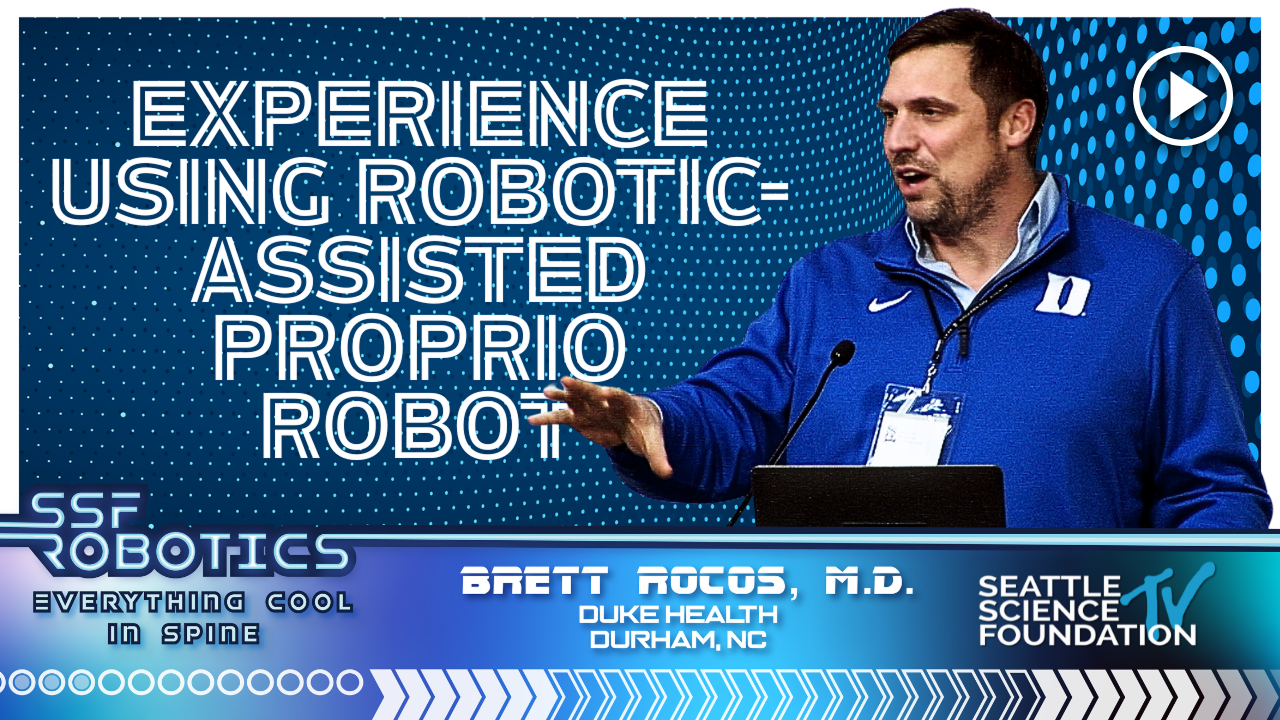
The video above captures a moment many spine surgeons recognize immediately: a growing mismatch between how we talk about robotics and the future of robotics in the operating room.
The next evolution in spine robotics is not about a better physical arm. It’s about real-time intelligence, systems that can help surgeons see, measure, and adapt as surgery unfolds. You can watch that idea play out in the presentation above, or read on for the core principles and why they matter.
In spine surgery, “robot” has largely come to mean a mechanical actuator: stable, precise, repeatable. That capability has tremendous value. But precision alone doesn’t define intelligence.
A more useful definition of a surgical robot includes a system that can:
If a system can sense, interpret, and respond continuously in the OR, it behaves like a robot, even if its primary output is information, not motion.
Aviation didn’t become safer because planes got prettier wings. It became safer when autopilot systems introduced intelligence that could sense and respond continuously.
Spine surgery is in a similar phase. Many current robotic systems excel at executing a predefined plan with impressive accuracy. But surgery is not a static environment, and execution alone doesn’t address what surgeons face intraoperatively.
What’s missing is a co-pilot: an intelligent system that keeps the map current while anatomy changes, tissues relax, and correction progresses.
Static plans collide with a dynamic spine
Most surgical planning workflows still rely on static images, often CTs captured before meaningful surgical work begins.
Once surgery starts, those conditions immediately are outdated:
If navigation remains anchored to a historical snapshot, the system is guiding against a virtual spine, not the one on the table.
This is where familiar issues arise: frame shift risk, verification loops, workflow interruptions, and delayed confirmation of whether alignment goals have actually been reached.
Many robotic workflows are fundamentally one-way:
High-performing OR teams don’t work that way. They rely on constant feedback:
The next phase of robotics brings that same model into the technology itself: continuous sensing, continuous measurement, and meaningful feedback while decisions are still being made.
When anatomy and spinal alignment can be tracked and measured in real time, the workflow changes fundamentally:
This is about doing what is required in the moment most effectively and efficiently, and stopping when the goal is reached.
Paradigm approaches navigation through computer vision and AI, not repeated imaging.
In practice:
When anatomy moves, tracking updates because the system is watching the anatomy itself, not inferring position from a prior scan.
This directly addresses long-standing surgeon frustrations around:
If alignment truly matters, it can’t be measured only after the fact.
A modern standard looks like:
This enables a simple but powerful question to be answered objectively:
Have we already reached the target, and if so, what can we safely avoid?
A complex deformity case shows what changes when alignment is measurable in real time
In the deformity case shown above, the expectation was a long, high-risk operative day with multiple major correction steps.
What real-time measurement revealed was unexpected but decisive: positioning, relaxation, and early releases had already moved alignment close to target before aggressive correction began.
That information changed the surgical path:
Estimated downstream effects included avoided implant and graft costs and several hours of OR time saved. These are case-specific estimates that illustrate a broader truth: measurement can enable simplification.
Across discussions following the presentation, the same priorities surfaced:
Surgeons aren’t asking for novelty. They’re asking for systems that hold up when cases are long, anatomy is complex, and plans inevitably change.
Robotic arms will continue to matter. They are powerful, precise end effectors.
But the larger shift is upstream:
Robotics is evolving from systems that execute plans to systems that continuously enable surgeons to update those plans based on reality in the moment.
None of this replaces the surgeon.
Human judgment still governs:
An intelligent co-pilot doesn’t take control. It expands objective, real-time perception, so surgeons can make better decisions sooner, with more confidence.

.svg)


